
Blog · Design
Solar Design Software Comparison: A Head-to-Head Review
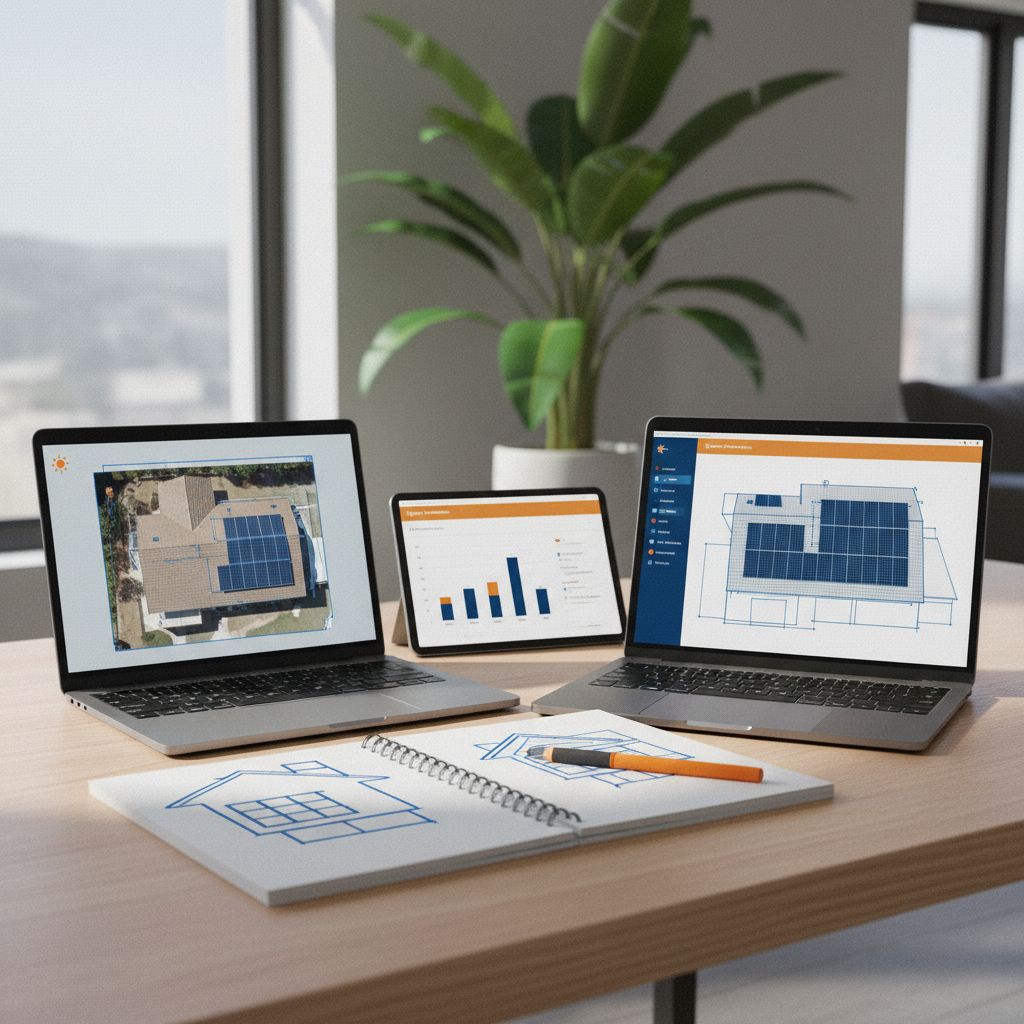
Choosing the right solar design software is a critical decision for any solar energy company. The market offers many tools, each with different strengths. Your choice impacts design accuracy, proposal efficiency, and ultimately, your project's profitability. This guide cuts through the noise. It provides a direct comparison of leading options, helping you select the best fit for your operations.
The Core Function of Solar Design Software
Solar design software does more than just draw panels on a roof. It precisely models energy production, visualizes system layouts, and calculates savings for your customers. These tools integrate various data points: irradiance, shading, roof characteristics, and utility rates. A robust platform ensures your designs are accurate and your proposals compelling.
Effective Choosing the Best Solar Sales Software: Comprehensive Guide relies heavily on accurate design data. This forms the foundation of your sales pitch and financial projections.
Key Factors for Solar Design Software Comparison
When evaluating solar design tools, consider several key areas. These factors determine the software's ability to meet your operational demands and support your sales efforts.
Accuracy in Energy Production Estimates
Precise energy yield forecasting is paramount. Your proposals promise specific savings. Inaccurate estimates lead to disappointed customers and potential financial liabilities. Look for software that uses validated irradiance data and advanced shading analysis. Per-panel modeling capability is crucial here. It accounts for individual panel performance under varied conditions.
Speed and Efficiency of Design Generation
Time is money in solar sales. Your team needs to generate designs quickly. Manual processes slow down your sales cycle. The best pv design software allows rapid iteration. It provides automated layout suggestions and drag-and-drop interfaces. This speeds up proposal generation without sacrificing accuracy.
Proposal Generation and Customer Experience
Designs become sales through effective proposals. Your solar design software should create professional, clear, and customizable proposals. These proposals must articulate the value proposition. They should detail energy savings, environmental benefits, and financial projections. Visualizations, including 3D solar modeling, help customers understand the system and its impact.
Integration with CRM and Other Business Tools
Standalone software creates data silos. An integrated solution streamlines your workflow. It connects design data with your CRM, financing platforms, and project management tools. This reduces manual data entry and minimizes errors. Evaluate how well a platform fits into your existing tech stack.
Cost and Scalability
Software costs vary significantly. Consider subscription fees, per-project charges, and any additional modules. Scalability is also vital. Your chosen solution must grow with your business. It should handle increasing design volumes and new team members without performance degradation.
Head-to-Head: Aurora Solar vs. OpenSolar and Other Leading Tools
Let's compare some of the prominent players in the solar design software market.
Aurora Solar: Detailed Accuracy and Robust Features
Aurora Solar is known for its high-fidelity 3D modeling and precise energy production simulations. It offers comprehensive shading analysis and validates its accuracy against real-world performance data. This tool supports complex residential and commercial designs. It provides detailed financial analysis and professional proposal templates. Aurora Solar is a powerful choice for companies prioritizing scientific accuracy and extensive feature sets. However, its advanced capabilities come with a steeper learning curve and higher price point.
OpenSolar: Free, Cloud-Based, and Accessible
OpenSolar offers a free-to-use, cloud-based platform. This makes it highly accessible for startups and smaller operations. It provides 3D design capabilities, energy production estimates, and proposal generation. OpenSolar focuses on ease of use and integrates with various third-party services. While it may not match Aurora's depth in certain simulation aspects, its cost-effectiveness and accessibility are significant advantages. It represents a strong option for companies looking to minimize software overhead.
Other Notable Solar Design Tools
Solargraf: Offers a user-friendly interface with quick design capabilities and integrated financial analysis. It balances ease of use with robust features.
PVsyst: A highly technical tool used primarily by engineers for detailed system performance analysis and validation. It is less focused on proposal generation for sales teams.
HelioScope: Known for its rapid design capabilities and comprehensive API for integration. It is favored by larger engineering teams and developers for system optimization.
Your specific needs will dictate the best choice. For a deeper dive into platform capabilities, review Key Features to Look for in an All-in-One Solar Sales Platform.
Solentrex: Streamlining Your Design-to-Close Process
Solentrex integrates critical aspects of your solar business, including design and proposal generation. Our platform ensures design accuracy with per-panel modeling. This helps you present guaranteed savings to customers and helps eliminate change orders by ensuring precise system sizing from the outset.
Our system imposes a hard gate. It prevents flawed deals from advancing. This means every design moving forward meets your profitability and performance standards. This level of rigor was previously unavailable. Legacy tools permit incorrect designs and proposals to reach the customer. This leads to costly revisions and lost sales.
Solentrex provides real-time interval data integration. This allows for precise consumption modeling. Your proposals reflect actual customer energy use. This bolsters confidence in projected savings. The entire design-to-proposal process takes about 3 minutes. Your reps can generate accurate, compelling proposals on the spot.
This efficiency directly impacts your sales pipeline. Faster, more accurate proposals mean more closed deals. For insights on managing your finance partnerships, refer to Evaluating Solar Financing Platforms: What Finance Partners Need to Know.
Common Mistakes to Avoid When Choosing Solar Design Software
Prioritizing Price Over Performance
Selecting the cheapest option can be costly in the long run. Inaccurate designs lead to project delays, reworks, and customer dissatisfaction. Invest in a tool that guarantees accuracy and supports your sales process.
Ignoring Integration Capabilities
Disjointed software creates manual work and introduces errors. Choose a platform that integrates with your CRM, financing tools, and other essential systems. This streamlines your entire workflow.
Overlooking Training and Support
Even the best software is useless if your team cannot effectively use it. Evaluate the vendor's training resources and customer support. Ensure your team can quickly get up to speed and resolve issues.
Neglecting Scalability Needs
Your business will grow. Your software must scale with it. Ensure the chosen solution can handle increased user loads and design volumes without performance issues.
Conclusion
Choosing the right solar design software is a strategic investment. It directly impacts your accuracy, efficiency, and profitability. Conduct a thorough solar design software comparison. Evaluate options based on your specific operational needs and sales process. Solentrex offers a comprehensive solution. It combines design precision with streamlined proposal generation. This ensures every deal is solid from the start. Take control of your design process. Empower your sales team with accurate, reliable tools.
Ready to transform your design-to-sale workflow and ensure every proposal is flawless? Contact Solentrex today for a demo.
Frequently asked questions
What is the primary difference between Aurora Solar and OpenSolar?
Aurora Solar offers highly detailed 3D modeling and validated accuracy, making it ideal for complex projects, though it has a higher cost. OpenSolar is a free, cloud-based platform focused on accessibility and ease of use, suitable for startups or smaller operations, though it may have less simulation depth.
Why is per-panel modeling important in solar design software?
Per-panel modeling accounts for the performance of individual solar panels under varying conditions, such as shading and tilt. This leads to more accurate energy production estimates and guaranteed customer savings, preventing costly change orders later.
How does solar design software improve the sales process?
Effective solar design software accelerates proposal generation, provides professional 3D visualizations, and offers accurate financial projections. This empowers sales teams to present compelling, reliable proposals quickly, increasing close rates and customer confidence.
What is a 'hard gate' in solar software, and why is it beneficial?
A hard gate is a feature that blocks flawed or unprofitable solar designs and proposals from advancing in the sales pipeline. This prevents costly errors, rework, and customer dissatisfaction by ensuring all projects meet predefined accuracy and profitability standards before they reach the customer.
Can solar design software integrate with other business tools?
Yes, leading solar design software platforms often integrate with CRMs, financing platforms, and project management tools. This streamlines workflows, reduces manual data entry, minimizes errors, and creates a more cohesive operational environment.