
Blog · Industry
Evaluating Solar CRM vs. All-in-One Platforms
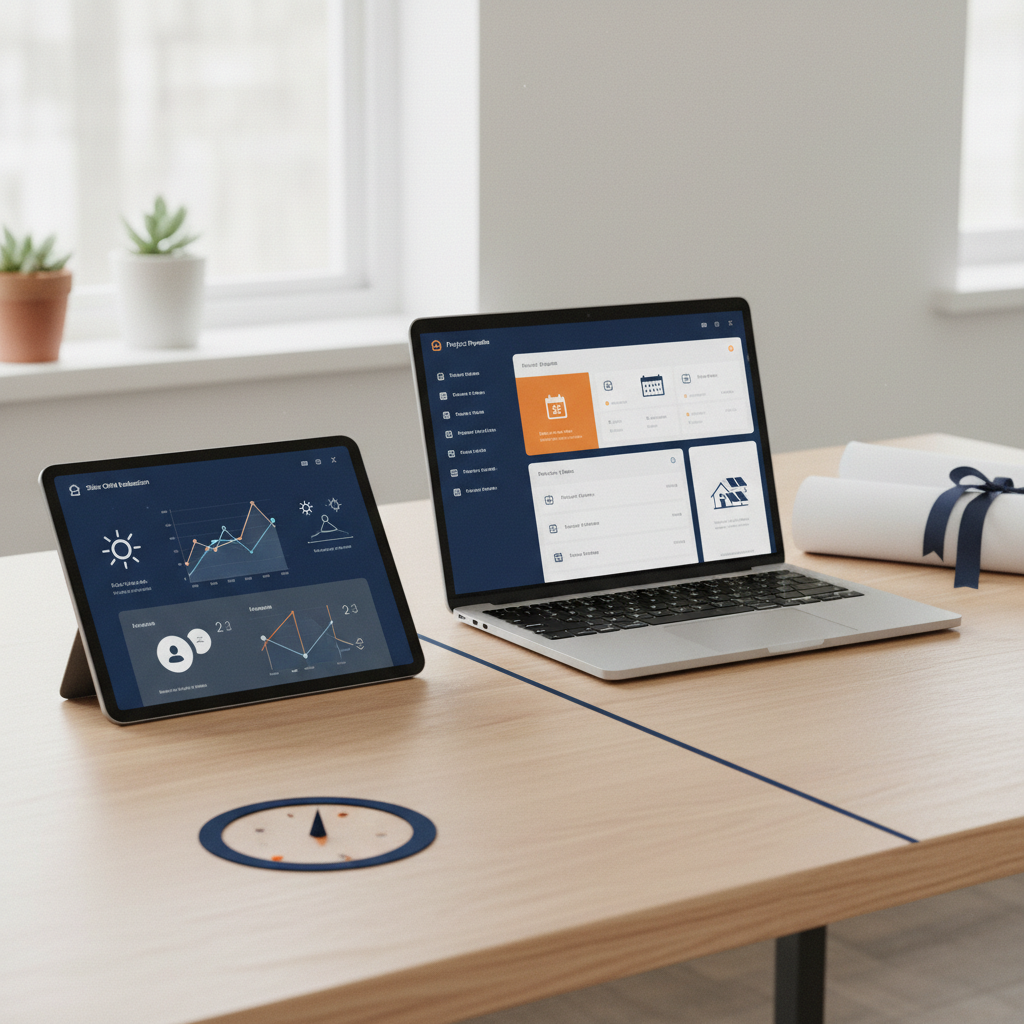
Your solar business runs on efficiency. Every lead, every proposal, every installation requires precise management and you need tools that perform. The choice between a dedicated solar Customer Relationship Management (CRM) system and an integrated all-in-one solar platform is fundamental. It impacts your team's workflow, your sales velocity, and your bottom line. We will compare these options directly, focusing on operational impact and proven results. Solentrex provides the hard gates you need to move deals forward with confidence.
This article specifically addresses Component 2: CRM and Sales Management – Beyond Basic Tracking, as outlined in our Choosing the Best Solar Sales Software: A Comprehensive Buyer's Guide for 2026.
Understanding Solar CRM: Core Functions and Benefits
A solar CRM focuses on customer interactions. It manages your sales pipeline from initial contact through post-installation follow-up. A CRM organizes leads, tracks communication history, schedules appointments, and sets tasks for your sales team.
Advantages of Standalone Solar CRM
Standalone CRMs offer deep customization. You can tailor fields, workflows, and reports to your exact sales process. They excel at managing customer data and communications. Many CRMs integrate with a vast ecosystem of third-party tools, offering flexibility.
Specialized Focus: Dedicated to customer interaction. No distractions from design or operations. Your reps manage customer data efficiently.
Customization: Adaptable to unique sales methodologies. Define your stages and set your triggers.
Integration Flexibility: Connects with various external tools. You choose your best-of-breed solutions for other functions.
Disadvantages of Standalone Solar CRM
Standalone CRMs often create data silos. Information does not flow seamlessly to other departments leading to manual data entry, errors, and significant delays. Design, permitting, and financing teams often work outside the CRM. This is a common challenge with solar sales management tools that are not fully integrated.
Data Silos: Customer data often remains isolated. You get disconnected information flows.
Integration Complexity: Integrating multiple systems requires IT resources. Managing these integrations adds overhead.
Limited Scope: Does not handle solar-specific tasks. No design tools, no financing applications and no permitting automation.
Increased Manual Work: Data transfer between systems creates re-entry points. Your team duplicates efforts costing time and introduces errors.
The All-in-One Solar Platform: Integrated Efficiency
An all-in-one solar platform integrates all core business functions. This includes CRM, design, proposal generation, financing, project management, and reporting. It provides a single source of truth for your entire operation. These are integrated solar solutions built specifically for your industry.
Advantages of All-in-One Solar Platforms
All-in-one platforms deliver end-to-end process control. They eliminate data silos and automate handoffs between departments. Solentrex, for example, provides a hard gate at each critical step. This ensures proposals are accurate, financing is viable, and projects are viable before moving forward. This directly impacts your pipeline quality and reduces change orders.
Unified Data: All project data resides in one system. Your sales, design, and operations teams share real-time information.
Streamlined Workflows: Automated processes move deals through your pipeline faster. You have fewer manual handoffs and less re-entry.
Reduced Errors: Hard gates prevent flawed projects from advancing. Solentrex blocks incorrect designs or unfeasible financial terms saving costly rework.
Faster Sales Cycles: Automated proposals and integrated financing accelerate deal closure. Your reps focus on selling, not administrative tasks.
Comprehensive Analytics: Track performance across all departments. You get a complete view of your business health.
Disadvantages of All-in-One Solar Platforms
Adopting an all-in-one platform means a significant commitment. Customization options might be more constrained than a standalone CRM. You align your processes with the platform's structure.
Vendor Lock-in: Switching providers can be challenging. Your data and workflows are deeply embedded.
Learning Curve: Comprehensive platforms require thorough training. Your team needs time to adapt.
Less Niche Customization: May offer less granular customization for specific CRM functions. You get robust solar-specific features instead.
Key Features of Integrated Solar Sales Management Tools
Whether you choose a standalone CRM with robust integrations or an all-in-one platform, certain features are non-negotiable for effective solar sales management. Our focus on integrated solar solutions highlights these critical components.
Lead Management and Tracking
Your system must capture, qualify, and track leads effectively. This includes automated lead assignment, status updates, and lead scoring. You need to see where every lead stands in your pipeline.
Proposal Generation and E-Signature
Automated proposal generation saves hours. It ensures consistency and accuracy. Integrated e-signature capabilities shorten sales cycles. Solentrex generates detailed, accurate proposals in about 3 minutes removing a significant bottleneck.
Integrated Financial Analysis
Accurate financial modeling is critical. The system must quickly calculate savings, payback periods, and ROI. It must integrate with financing partners. This is where Key Features to Look for in Robust Solar Financing Integration Software becomes essential. Our platform provides real-time financial analysis to guarantee customer savings, which then translates into guaranteed project revenue for you.
Design Integration and Accuracy
Sales teams need access to accurate design data. Per-panel modeling ensures precise energy production estimates. A platform that ties design directly to the proposal prevents costly errors. This contrasts with tools where design and sales operate in separate vacuums. For more on this, refer to Top Solar Design Software Platforms: Features, Accuracy, and Integrations Compared.
Project Management and Task Automation
Post-sale, the system must manage project milestones, tasks, and communication. Automated notifications keep everyone informed and ensures smooth handoffs from sales to operations.
Reporting and Analytics
Robust reporting reveals performance gaps and opportunities. Track conversion rates, sales velocity, and team performance to identify bottlenecks in your pipeline. Your investment in solar sales software should always show a clear ROI. Consider reading The ROI of Solar Sales Software: Calculating Your Platform's Value for a deeper dive.
The Solentrex Difference: Hard Gates for Quality and Profitability
Solentrex operates on the principle of the hard gate. This is not merely tracking; it is active prevention. Before a deal progresses, it must meet predefined, rigorous criteria. This includes validated design data, confirmed financial viability, and accurate customer savings projections.
Design Hard Gate: Your team builds per-panel models in 3 steps. The system verifies energy production and validates against actual site conditions. If the design is flawed, the deal does not proceed. This eliminates costly change orders after the contract is signed.
Financial Hard Gate: The platform generates detailed financial analysis. It projects accurate customer saving and confirms loan or lease terms. If the financial package is not viable for the customer, it flags the issue. Your sales reps only present viable options.
Proposal Hard Gate: A complete and accurate proposal is generated only after all previous gates are cleared. This means no manual errors in pricing or terms and every proposal is ready for signature.
This proactive approach guarantees deal quality, reduces cancellations, protects your profit margins, and builds customer trust. Your sales team can confidently present proposals knowing the backend is solid.
Making Your Decision: Solar CRM Evaluation or All-in-One?
Consider your current pain points. Are data silos slowing you down? Are change orders eating into profits? Do your sales teams spend too much time on administrative tasks? Your solar crm evaluation should address these questions directly.
If you have a complex, multi-tool tech stack that requires constant manual data transfer, an all-in-one platform like Solentrex offers significant advantages. It consolidates your solar sales management tools into one cohesive system. If your business primarily needs advanced customer communication and already has robust, integrated solutions for other functions, a highly customized standalone CRM might fit. However, true integration requires significant IT investment and ongoing maintenance.
Think about the long-term. As your business grows, scalability becomes critical. An integrated system simplifies expansion and future-proofs your operations. Consider Future-Proofing Your Solar Sales Tech Stack for strategies on how to approach this.
Conclusion: Choose Efficiency, Choose Profitability
The decision between a standalone solar CRM and an all-in-one solar platform hinges on operational efficiency and risk reduction. Standalone CRMs offer flexibility but can create fragmentation. All-in-one platforms provide seamless workflows, reduce errors, and accelerate sales cycles. Solentrex delivers this integrated power with its hard gate system, ensuring every deal is solid. It transforms your pipeline from a series of hopeful leads into a flow of guaranteed projects. Take control of your sales process and drive predictable growth. Your business deserves a solution that locks in success.
Ready to see how Solentrex streamlines your sales, design, and financing workflows? Contact us today for a personalized demonstration.
Frequently asked questions
What is the primary difference between a standalone solar CRM and an all-in-one solar platform?
A standalone solar CRM focuses exclusively on managing customer relationships, lead tracking, and communication. An all-in-one solar platform integrates CRM functions with solar-specific design, proposal generation, financing, and project management tools, providing a single system for all operations.
How do 'hard gates' improve the solar sales process?
Hard gates are critical checkpoints within an all-in-one platform that prevent a deal from advancing unless specific, predefined criteria are met. For example, a design must be validated, and financial terms confirmed, before a proposal can be generated. This proactive error prevention reduces change orders and increases deal profitability.
Can a standalone CRM achieve the same integration as an all-in-one platform?
While a standalone CRM can integrate with other tools, achieving the same level of seamless, real-time integration as a purpose-built all-in-one platform often requires significant IT resources, complex custom development, and ongoing maintenance. Data silos and manual handoffs are still common challenges.
What are the benefits of using an all-in-one solar platform like Solentrex?
All-in-one platforms offer unified data, streamlined workflows, reduced errors through hard gates, faster sales cycles due to automated processes, and comprehensive analytics. Solentrex, for example, generates accurate proposals in about 3 minutes and ensures project viability from the outset.