
Blog · Solar Sales
Comparing Design Capabilities of Leading Solar Platforms
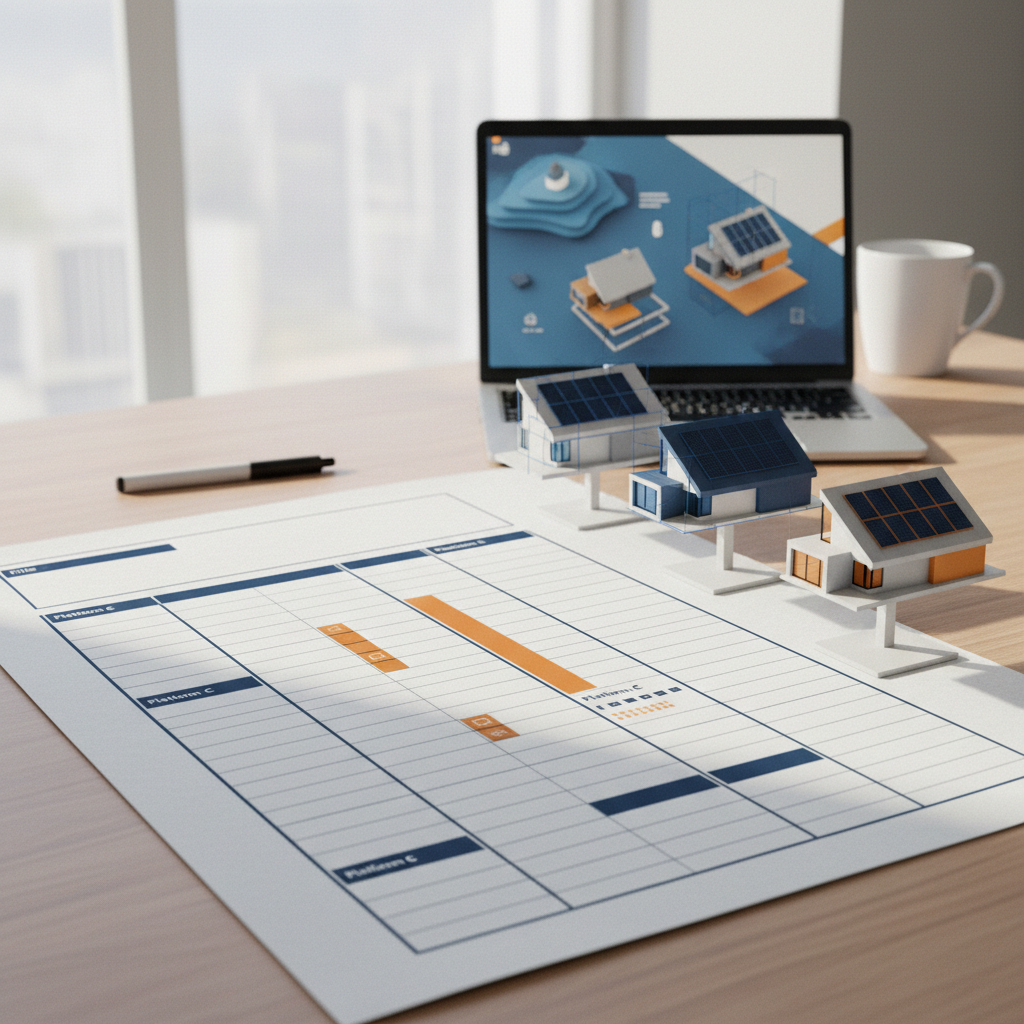
Accurate solar design is the bedrock of your sales process. Without it your proposals generate change orders, your sales pipeline slows, and profits erode. This article breaks down the solar design capabilities of leading sales platforms. You will understand the differences and see what matters for your business.
Solar sales platforms must do more than just draw panels on a roof. They need precise modeling, quick iteration, and need proposals that close deals without rework. This guide compares platforms on core design features focusing on accuracy, speed, and integration within your broader sales workflow. You can then make an informed choice for your team and pick the right tool for your specific needs.
The Crucial Role of Accurate Solar Modeling Platforms
Accurate solar modeling is not a perk, it is a requirement. Inaccurate designs lead to lost revenue, create customer distrust, and waste your team's time. A platform that miscalculates energy production, panel placement, or shading creates problems downstream. Your reps spend time defending numbers, installers encounter site issues, and your finance partners question deal viability.
Precise 3D solar design tools eliminate these risks. They ensure your proposals reflect reality and lock in performance guarantees reducing post-sale adjustments. This level of accuracy builds confidence with both your customers and your financing partners. It is a key differentiator in your market.
Why Design Accuracy Impacts Your Bottom Line
Every percentage point of error in energy production modeling affects customer savings. A system modeled at 500 kWh per month that only produces 400 kWh is a problem. The customer feels misled and this creates a lot of unneeded problems.
High-accuracy platforms use detailed irradiance data and model panel-level performance. They account for complex shading scenarios and integrate with granular utility rate data. This comprehensive approach ensures your predicted savings are reliable, financial models hold up, and your deal flow remains predictable.
Key Comparison Criteria for Solar Design Software
When evaluating a solar design software comparison chart, focus on specific, measurable criteria. These criteria dictate how quickly and accurately your team can generate proposals. They also determine the integrity of your deals.
1. 3D Modeling Precision and Data Sources
Top platforms use high-resolution aerial imagery. They integrate with LiDAR data or other accurate terrain models providing the foundation for precise 3D roof models. Lower-tier platforms may rely on less accurate satellite imagery or manual input introducing significant error potential.
What to look for:
- High-resolution imagery: Evaluate the clarity and recency of the aerial maps. Can the platform discern small roof features, vents, and chimneys?
- Terrain and obstruction modeling: Does the platform accurately model pitch, azimuth, and complex roof facets? Does it model near-field and far-field shade objects with high fidelity? Solentrex, for example, models per-panel. It uses 3D structures for accurate shading profiles.
- Data refresh rates: How often is the underlying imagery updated? Outdated imagery can lead to design errors, especially in newly developed areas. Solentrex vs. Industry Competitor A: Which Solar Sales Platform Reigns Supreme?
2. Speed of Design Generation and Iteration
Your sales reps need to design systems quickly and make changes on the fly. Slow design tools kill sales momentum while frustrating customers. They limit the number of proposals your team can generate in a day.
What to look for:
- Automated design features: Does the platform automatically place panels? Can it optimize for production or cost? Solentrex's automated design often takes about 3 minutes to produce a ready-to-present proposal.
- Real-time adjustments: Can reps quickly modify panel layouts, add batteries, or change component selections? Does the system instantly recalculate production and financials?
- Template functionality: Can you create standard system templates for common roof types or customer segments to streamline the design process for your team.
3. Energy Production Simulation Accuracy
This is where the rubber meets the road. Your solar proposal visualizer must predict energy output with extreme accuracy to ensure customer savings are guaranteed.
What to look for:
- Interval data integration: Can the platform integrate with historical interval data from utility Smart Meters? This provides highly granular load matching and more accurate savings projections. Solar Financing Integration Comparison: Speed, Lenders, and Customer Experience
- Shading analysis: How detailed is the shading analysis? Does it model dynamic shading throughout the day and year? Does it apply shading calculations per panel? Solentrex uses per-panel modeling for shade, ensuring granular accuracy.
4. System Component Library and Customization
A robust component library is essential. Your team needs access to the latest panels, inverters, and batteries. You need to design systems with your preferred equipment.
What to look for:
- Comprehensive database: Does the platform maintain an up-to-date database of solar modules, inverters, and battery storage solutions? Can you easily add new components?
- Customizable pricing: Can you input your own pricing for hardware and labor? Does the platform allow for tiered pricing or specific markups?
- Balance of System (BOS) considerations: Does the design tool account for racking, wiring, and other BOS components? Can it estimate costs associated with these items?
5. Integration with Sales and Financing Workflows
A design tool isolated from your sales process causes friction. The best platforms integrate design directly into proposal generation, financing applications, and contract management. This creates a cohesive pipeline and ensures data consistency.
What to look for:
- Proposal generation: Does the design automatically flow into a professional, customer-facing proposal? Does it include 3D renderings and consumption graphs?
- Financing integration: Can the design data feed directly into lender applications? This avoids manual data entry and reduces errors. Your hard gate mechanism should use these design and finance numbers to block any deal likely to fail.
Avoiding Common Mistakes in Solar Design Tool Selection
Many businesses make mistakes when choosing a solar design platform. These errors lead to unmet expectations and wasted investment. Avoid them by focusing on real-world use cases.
- Prioritizing flashy visuals over accuracy: A beautiful proposal is useless if the underlying numbers are wrong. Always verify the modeling engine's precision.
- Ignoring integration needs: A standalone design tool creates data silos and hinders your team's efficiency. Ensure the platform fits into your existing tech stack.
- Underestimating the need for iteration: The tool must be fast and responsive. If it slows them down, they will find workarounds.
- Neglecting training and support: Even the best software requires proper training. Evaluate the vendor's support resources to ensure your team can maximize the platform's capabilities.
Solentrex: Design That Drives Deals
Solentrex delivers design capabilities engineered for speed and accuracy. Our platform integrates high-resolution imagery, granular shade analysis, and per-panel modeling. This guarantees accurate energy production estimates and ensures your customers receive reliable savings projections.
Our system delivers an accurate residential solar design in about 3 minutes resulting in your reps spending more time selling and less time designing. This drives your sales efficiency. Solentrex's hard gate prevents flawed deals from advancing and ensures only viable projects reach the next stage. Your team and finance partners can trust the numbers.
Ready to see how precise solar design can transform your sales process? Explore Solentrex. Understand how our platform gives your team confidence in every proposal. Our solution supports your entire workflow, from design to financing to close. Visit our website to schedule a demo.
Frequently asked questions
What is the difference between 2D and 3D solar design?
2D solar design is a flat representation and lacks accurate shading analysis or roof pitch considerations. 3D solar design creates a realistic model of the roof and surrounding environment. It precisely calculates solar access, shading, and energy production for each panel. This leads to far more accurate proposals.
How important is PVSyst-level modeling in a solar design platform?
PVSyst-level modeling is crucial. It means the platform uses advanced algorithms to factor in environmental conditions like temperature, module degradation, and inverter efficiency. This delivers highly accurate energy production estimates. It ensures your customer's savings projections are reliable.
Can a design platform integrate with actual utility interval data?
Yes, leading design platforms can integrate with historical interval data from utility smart meters. This provides a detailed understanding of customer energy consumption patterns. It allows for highly granular load matching and more precise savings calculations in your proposals.
What is a 'hard gate' in the context of solar sales platforms?
A hard gate is a critical feature in a solar sales platform. It prevents flawed or unviable deals from progressing in the sales pipeline. This ensures that proposals with inaccurate designs, incorrect pricing, or mismatched financing criteria are flagged and corrected before costly errors occur. It locks down the numbers for your team.
How quickly should a solar design platform generate a proposal?
A top-tier solar design platform should generate a complete, accurate, and presentable residential solar design in about 3 minutes. This includes a full bill of materials and performance guarantees. This speed is critical for maximizing sales efficiency and responsiveness.
Why is per-panel modeling important for shade analysis?
Per-panel modeling for shade is vital because it calculates the impact of shading on each individual solar panel. This provides a much more granular and accurate energy production estimate than system-wide or array-wide shading assumptions. It ensures that the specific conditions of each panel are considered.