
Blog · Solar Sales
6 Signs Your Solar Sales Workflow Needs a Multi-Lender Waterfall Engine
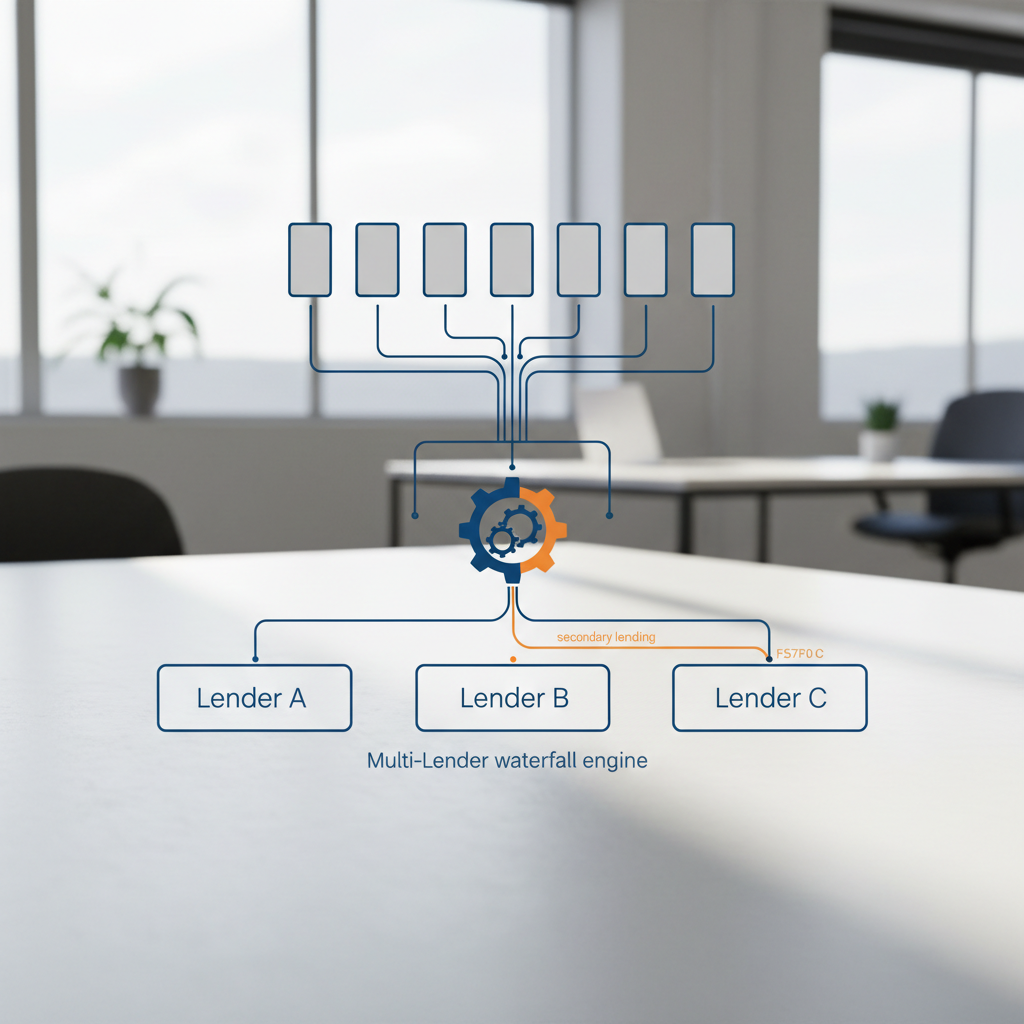
A single credit denial should never kill a clean solar deal. Yet it happens in kitchen tables and sales calls every day. Your rep builds an accurate layout. They size the system using per-panel modeling. They run the credit application through your primary lender. The application gets declined. The rep packs up their laptop, leaves the home, and moves on to the next lead.
That customer wanted solar. The roof was viable. The utility bill was high enough to justify the economics. But your sales stack had only one financial path.
When you depend on a single finance provider, you surrender control of your pipeline. Near-prime customers get discarded. Prime buyers get pushed into loan structures that do not match their tax strategy. To protect your revenue, you need an automated waterfall mechanism that routes applications across multiple capital sources in real time.
Here are the 6 signs your sales workflow needs a multi-lender waterfall engine, backed by clear operational steps to fix the leak.
1. Credit Turn-Downs Trigger Immediate Deal Fallout
The most obvious sign of a broken workflow is simple: a denial from your tier-one lender marks the end of the deal.
Most primary lenders look for a 650 or 680 FICO score. If a customer sits at 635, the primary lender rejects the application. In a standard workflow, the sales rep must open a second tab, log into a secondary solar lending portal, and manually re-enter the homeowner's personal data.
Manual re-entry fails for three reasons:
- The customer loses confidence in the process.
- The rep avoids the extra paperwork and abandons the deal.
- Entering data twice introduces typos that cause secondary rejections.
A multi-lender solar platform removes manual re-entry entirely. In The Definitive Guide to Integrated Solar Financing: Automating Credit, Approvals, and Lender Alignment, we detail how automated credit routing passes applicant data instantly to secondary capital partners. If Lender A declines, the application routes to Lender B within seconds.
2. Your Reps Choose Lenders Based on Dealer Fees, Not Approvals
Give sales reps five separate dealer portals, and they will make decisions based on memory rather than program math.
Reps often route every deal to whichever lender has the lowest dealer fee at that specific moment. Alternatively, they default to the portal whose password they remember. They submit near-prime borrowers to prime-only lenders. The application gets kicked back. The sales cycle stretches from 3 days to 3 weeks.
A true solar waterfall financing engine removes the guesswork. You set programmatic business rules in advance:
- Define primary, secondary, and tertiary capital tiers.
- Filter criteria based on credit score bands, debt-to-income limits, and roof ownership.
- Automatically present the exact loan or PPA product that fits the customer profile.
When you integrate rules directly into the quoting tool, the software enforces your policy. The rep focuses on presenting the utility offset and the monthly payment.
3. Disconnected Portals Are Burning Back-Office Hours
Look at your operations desk at the end of the month. If your project managers are cross-referencing three lender dashboards with your CRM, your pipeline is bleeding overhead.
Every disconnected portal creates friction:
- Milestone payments get missed because no one updated project milestones across systems.
- Change orders require manual cancellation in one portal and manual creation in another.
- Operations teams spend hours tracking down stipulations such as proof of income or property deed verification.
To understand the full financial impact of this operational friction, see Why Disconnected Dealer Portals Are Costing Solar Companies Thousands. A unified multi-lender solar platform acts as a single operational layer. Your team submits, tracks, and manages credit decisions in one window.
4. You Lack Soft-Credit Filtering Upfront
Running hard credit inquiries as your first step damages customer trust and burns sales time. If your team spends 45 minutes calculating sun hours, building an offset profile, and collecting signatures before checking credit, you are wasting labor on non-viable deals.
A modern waterfall engine runs soft-credit pre-qualification at the start of the sales flow. It takes about 3 minutes. The rep collects basic customer information and pulls a soft credit report that leaves zero impact on the customer's credit score.
The system reads the credit band and instantly exposes the viable financing paths. As outlined in How Instant Soft-Credit Pre-Qualification Prevents Solar Stalled Deals, this early data point acts as an operational guide. Your rep presents only the programs the customer qualifies for.
5. You Cannot Easily Shift Between Loans, Leases, and PPAs
Solar markets change quickly. Interest rate spikes increase loan dealer fees. In response, customers often pivot toward third-party ownership (TPO) structures such as leases and power purchase agreements (PPAs).
If your sales workflow relies on one loan provider and a separate lease provider, switching structures mid-sale is painful. The rep must restart the proposal from scratch. This friction kills buyer momentum.
A waterfall engine supports dynamic product switching:
- The system evaluates the homeowner's tax appetite.
- It compares loan monthly payments against PPA rates side by side.
- If a customer fails the debt-to-income requirements for an ownership loan, the engine instantly presents a lease or PPA option.
Dynamic switching preserves the sale right at the kitchen table.
6. Contract Re-Signs Stall Projects After the Initial Close
A signed contract means nothing if the lender rejects the project parameters post-sale.
Single-lender workflows frequently hit this barrier:
- The rep quotes an adder or battery backup that exceeds the lender's maximum project size.
- The customer signs the primary agreement.
- The lender's underwriting department rejects the package three days later.
- Your operations team issues a change order, requiring a re-sign.
- The homeowner gets cold feet and cancels.
Our signature idea is the hard gate. The platform blocks a flawed deal from advancing before anyone signs.
A multi-lender waterfall engine embeds lender-specific underwriting criteria into the design tool. If an adder pushes the transaction over Lender A's project cap, the platform enforces the hard gate. It stops the rep from generating the contract. It prompts them to split the financing or route the deal to Lender B, whose program parameters accommodate the equipment package.
How to Implement a Solar Waterfall Engine in 3 Steps
Upgrading your sales workflow does not require rebuilding your company from scratch. Follow this 3-step deployment to establish secondary solar lending without disrupting active reps.
Step 1: Map Your Pipeline Fallout
Review your last 90 days of credit submissions. Identify the exact number of credit rejections. Group those rejections by credit score range and debt-to-income ratio. This data shows you exactly which secondary products you need in your waterfall, whether near-prime loans, zero-down leases, or specialized credit-union capital.
Step 2: Establish Lender Underwriting Rules
Define the hierarchy. Set your primary tier for prime credit profiles (typically 700+ FICO) to secure the lowest rates. Configure your secondary tier for near-prime profiles (typically 600 to 699 FICO). Set a tertiary tier for asset-backed or alternative lease options. Enter these criteria directly into your platform settings.
Step 3: Implement the Hard Gate at Point of Sale
Lock your workflows. Train your reps to run soft credit early in the discovery phase. Ensure the proposal tool locks the contract generation button until the platform confirms that the selected lender approves the system price, system offset, and customer credit tier.
By systematically directing capital applications based on locked lender criteria, your business retains viable deals, lowers customer acquisition costs, and speeds up time to install. To evaluate the broader picture of credit automation, read our comprehensive overview in The Definitive Guide to Integrated Solar Financing: Automating Credit, Approvals, and Lender Alignment.
Stop letting single-lender bottlenecks dictate your business revenue. Equip your sales team with automated multi-lender routing. Request a demo with Solentrex today to see how our platform secures approvals, enforces the hard gate, and protects your pipeline.
Frequently asked questions
What is a solar waterfall financing engine?
A solar waterfall financing engine automatically passes a customer credit application through a predetermined hierarchy of lenders. If the primary lender rejects the application, the system immediately routes it to secondary or tertiary lenders without requiring manual data re-entry.
What is the hard gate in solar software?
A hard gate is a programmatic platform rule that blocks an invalid or unfinanceable deal from progressing to contract generation. It stops reps from sending contracts that violate lender underwriting limits, eliminating post-sale re-signs and cancellations.
Does soft-credit pre-qualification damage a customer credit score?
Yes. Modern waterfall platforms use soft-credit pre-qualification that checks consumer credit files without affecting their credit score. This provides actionable credit tier data in about 3 minutes.
What credit score range qualifies as near-prime for solar financing?
Near-prime solar borrowers typically have credit scores between 600 and 679. While prime lenders often reject these scores, secondary solar lending partners offer specialized terms tailored to this audience.